
Wealthy Americans are buzzing about a tool that helps them lower their tax bills.
Those who give to charity flocked to donor-advised funds, which let them stockpile tax deductions. Adoption of the funds surged at the end of 2025 and has continued into 2026, according to some of the biggest providers.
Many people were aiming to get ahead of new rules in last summer’s tax law that limit tax breaks on charitable giving for high earners and those who itemize deductions. They have also been seeking to unload stock that exploded in value during the bull market of the last decade and a half.
Funding a new DAF with highly appreciated shares of stock allows the donor to avoid capital-gains taxes while also taking a tax deduction. The deduction occurs when they transfer assets to a DAF. The money can be invested within the DAF tax-free and doled out to charity years into the future.
The charitable-giving rule changes in the tax law had the biggest impact on high earners like many clients of Boston-based Civic Financial. After the new law passed, its advisers began recommending that their clients, which include law-firm partners, hedge-fund managers and private-equity executives, use a DAF for planned charitable gifts, according to Scott DeSantis, Civic’s chief executive officer.
Civic opened dozens of new DAFs for clients and more than doubled its assets under management in such vehicles between the passage of the law and the end of 2025.
“If somebody might give $50,000 a year, we’d be suggesting they contribute anywhere from four to eight times that,” DeSantis said.
Provisions in the new law affected people who itemize their deductions—typically a wealthier group than those who take the standard deduction. It created a new floor on the deduction for charitable contributions. Starting this year, charitable donations below 0.5% of adjusted gross income won’t be deductible.
Take someone who makes $1 million a year and has committed to giving $10,000 a year to charity over the next four years. Under the new rules, that person wouldn’t be able to deduct $5,000 of their 2026 donation. To counter that, the strategy for 2025 was to pull future donations forward and take a bigger onetime deduction. If this person instead donated $40,000 to a DAF at the end of 2025, they could take the full deduction, with the DAF distributing the money to the charity over the next four years.
The tax savings for that person would be between $5,000 and $7,400 at the federal level for the four-year period, depending on the composition of their income and assuming a tax rate of 37%, according to Miklos Ringbauer, a certified public accountant in Southern California.
Even those who missed the boat on opening a DAF last year might find it useful for bunching deductions into one tax year. That would make it easier to clear the new 0.5% floor in 2026 and onward, advisers say. At Vanguard Charitable, more people are opening new accounts in 2026 than would normally be expected at this time of year, according to President Rebecca Moffett.
Another change in the new tax law limited the tax benefit of itemized deductions for those in the highest tax bracket to 35%, rather than the previous 37%. That means a taxpayer in the highest bracket who gives $10,000 to charity beyond the 0.5% floor could deduct only $3,500, rather than $3,700.
A DAF can make sense for people who aren’t ultrawealthy if they plan to give to charity and itemize deductions.
Nelson and Christy Matzen knew they were going to itemize in 2025. The financial planners in New York regularly give to their church and the occasional school fundraiser.
They opened a DAF and funded it with a few stocks and exchange-traded funds that had big long-term gains. (DAFs can be funded with many kinds of assets.) They didn’t have to pay capital-gains taxes on their investments and got to take a deduction right away. For 2026 and 2027, they plan to fund most of their charitable gifts using their DAF.
“We said: Let’s get the full tax benefit instead of having higher hurdles going forward,” said Christy Matzen.
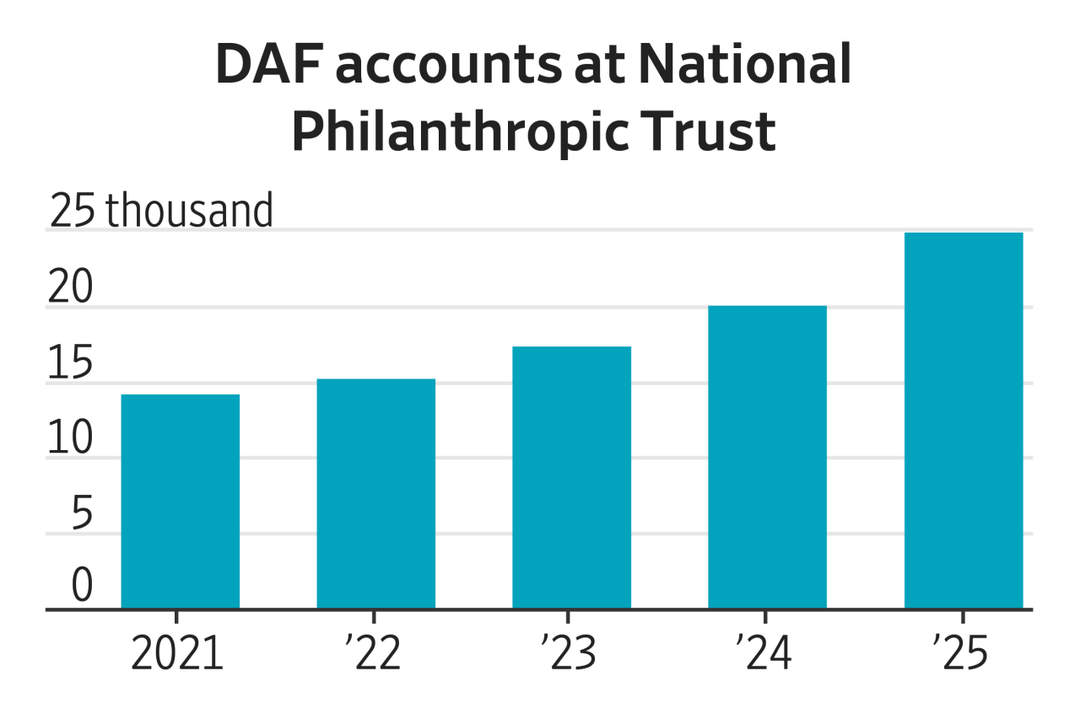
At National Philanthropic Trust, a major DAF provider, donors opened more than 3,700 new accounts in November and December of 2025, an increase of 123% from a year earlier. At Vanguard Charitable almost 2,600 new accounts were opened, a 99% increase.
DAFgiving360, formerly known as Schwab Charitable, saw contributions to accounts climb roughly 50% year over year in the fourth quarter.
Unlike private foundations, which are required under IRS rules to give away at least 5% of assets annually, DAFs have no federally mandated giving requirements. That has led to criticism that donors are parking money in them. Providers, whose asset-management fees range from around 0.1% to 1%, depending on the size of the DAF, also have little incentive to encourage giving, critics say.
In total, there were 3.56 million DAFs in 2024 containing $326 billion, according to the latest research from Donor Advised Fund Research Collaborative. About 25% of total assets in DAFs at the end of 2023 were paid out in grants the following year.
Some DAF providers say they are trying to encourage donors to put the money to use. San Francisco-based Regenerative Social Finance runs an investment fund that makes loans to nonprofits and businesses in areas such as climate, education and agriculture. It recently started waiving fees on money that DAF holders invest in the fund. Gains go back to the DAF for grant-making purposes.
“Sometimes it starts with a tax deduction,” said Kathleen Paylor, RSF’s vice president of impact investing and philanthropy. “Sometimes it ends there, and that’s the problem.”